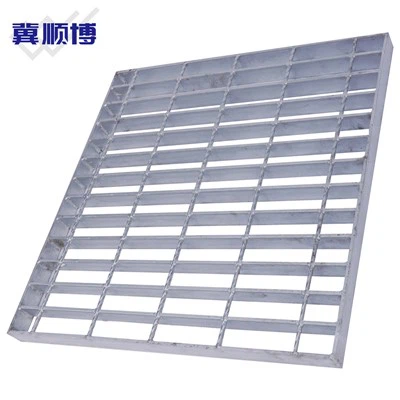

Can compound gratings be used in optical communication? Well, that's a question I get asked a lot as a supplier of Compound Grating. Let's dig into this topic and see what the deal is.
First off, let's understand what compound gratings are. Compound gratings are basically a type of grating that combines different grating elements or structures. They're made to have specific optical properties that can be useful in a bunch of applications. Unlike some other types of gratings like Plug Grating or Serrated Steel Grating, which are more commonly used in mechanical or architectural applications, compound gratings are all about optics.
In optical communication, the main goal is to transmit information using light. We use things like optical fibers to send data over long distances really fast. And here's where compound gratings come in. One of the key features of compound gratings is their ability to manipulate light in a very precise way. They can diffract light, which means they can split it into different wavelengths or directions. This is super important in optical communication because we often need to separate different channels of data that are being sent through the same optical fiber.
For example, in wavelength - division multiplexing (WDM), which is a widely used technique in optical communication, we send multiple signals at different wavelengths through a single fiber. Compound gratings can be used to demultiplex these signals at the receiving end. They can separate the different wavelengths so that we can pick out each individual data stream. This is crucial for increasing the capacity of optical communication systems.
Another advantage of compound gratings in optical communication is their ability to control the polarization of light. Polarization is an important property of light, and being able to manipulate it can improve the performance of optical communication systems. Compound gratings can be designed to interact with light in such a way that they can change its polarization state. This can be used to reduce interference and improve the signal - to - noise ratio.


But it's not all sunshine and rainbows. There are some challenges when it comes to using compound gratings in optical communication. One of the main issues is the manufacturing process. Making high - quality compound gratings is not easy. They require very precise fabrication techniques, and even small errors in the manufacturing process can have a big impact on their performance.
Another challenge is the cost. High - performance compound gratings can be quite expensive to produce. This can be a barrier for some applications, especially in cost - sensitive markets. However, as technology advances, we're seeing more cost - effective manufacturing methods being developed, which could make compound gratings more accessible in the future.
Let's talk about some real - world examples. In data centers, where there's a huge demand for high - speed data transmission, compound gratings can play a big role. They can be used to manage the large amount of data traffic by separating different wavelengths and channels. This helps to optimize the use of optical fibers and increase the overall efficiency of the data center.
In long - haul optical communication systems, compound gratings can also be used to improve the performance of the system. They can help to compensate for dispersion, which is a phenomenon that causes the different wavelengths of light to travel at different speeds in an optical fiber. By using compound gratings to correct for dispersion, we can ensure that the data arrives at the destination without significant distortion.
Now, I know you might be thinking, "This all sounds great, but how do I get my hands on these compound gratings?" Well, that's where I come in. As a supplier of compound gratings, I can offer you high - quality products that are designed to meet the needs of the optical communication industry. Whether you're working on a small - scale project or a large - scale infrastructure, I've got you covered.
If you're interested in using compound gratings in your optical communication applications, I'd love to have a chat with you. We can discuss your specific requirements, and I can provide you with more information about our products and how they can benefit your project. Don't hesitate to reach out and start a conversation about your optical communication needs.
In conclusion, compound gratings have a lot of potential in optical communication. They offer unique optical properties that can be used to improve the performance and capacity of optical communication systems. While there are some challenges, the benefits are significant. So, if you're in the optical communication business, it's definitely worth considering using compound gratings in your projects.
References
- Optics textbooks on grating theory and applications
- Research papers on the use of compound gratings in optical communication